When More Investment Risk May Not Equal More Return
Why today’s stock valuations and bond yields could favor a more defensive retirement portfolio
For investors nearing retirement, the goal is not simply to maximize investment returns. It is to generate enough growth and income to support retirement while managing the risk of losses that could derail the financial plan. That balance is especially important in today’s market, where elevated stock valuations and higher bond yields have changed the trade-off between stocks and high-quality bonds. Several major investment firms now project that U.S. stocks may have a smaller return advantage over high-quality bonds during the next decade than investors experienced over the past 10 years.
60/40 vs. 40/60 portfolio: Understanding the difference
A 60/40 portfolio holds about 60% in stocks and 40% in bonds. A 40/60 portfolio reverses those percentages. Stocks usually provide more long-term growth, but their value can rise and fall sharply. High-quality bonds generally provide income and stability, although they also carry risks and can lose value.
The 60/40 mix has long been a common starting point because it balances growth and stability. But it is not a rule, and it is not automatically right for every investor. When expected stock returns are unusually close to expected bond returns, owning more stocks may add considerably more ups and downs without adding much expected return.
Strong returns can create unrealistic expectations
Recent returns from U.S. stocks have been unusually strong. It can be tempting to look at those gains and assume that a larger allocation to stocks will continue to produce significantly higher returns. Long-term investment forecasts take a different approach: They start with today’s stock prices, valuations and bond yields to estimate what investors might reasonably expect going forward.
Consider a rental property. Even a good property can be a poor investment if you pay so much for it that the price already assumes rising rents, full occupancy and few repair costs. Stocks work the same way. A profitable company can still deliver modest future returns if investors have already paid a high price based on expectations for strong growth.
High stock valuations do not predict when the market will decline, and they can remain elevated for years. They do, however, leave less room for error. If profits grow more slowly than expected or investors eventually pay a more typical price for those profits, future stock returns could be lower—even if the economy continues to grow.
What the latest forecasts are saying
The latest published long-term assumptions, as of October 5, 2026, still show a fairly narrow gap between U.S. stocks and broad U.S. bonds. Schwab projects 5.9% a year for large-company stocks and 4.8% for aggregate bonds over 10 years. Capital Group projects 6.1% and 4.5%, respectively, over 20 years. J.P. Morgan projects 6.7% and 4.8% over 10 to 15 years. Vanguard publishes ranges rather than a single estimate: 4.2% to 6.2% for U.S. equities; and 4.3% to 5.3% for U.S. aggregate bonds over 10 years. The chart below uses the midpoint of each Vanguard range—5.2% and 4.8%—and labels the full ranges to the right.
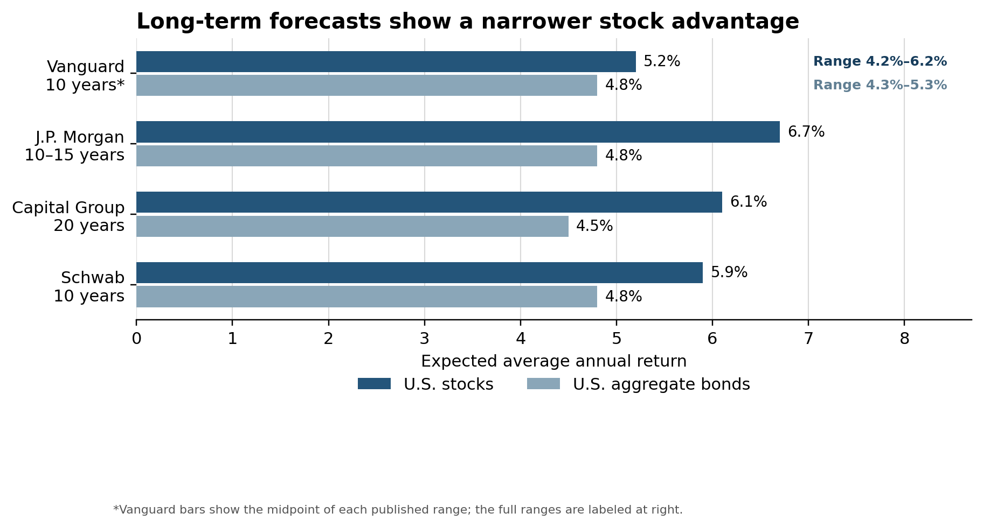
Vanguard’s modeling from June 30, 2026, adds a useful portfolio-level example. Its traditional 60% stock/40% bond benchmark had an expected annual return of 5.5% and expected volatility of 9.3%. A model-selected portfolio holding about 40% stocks and 60% bonds had a higher expected return of 5.9% and lower expected volatility of 6.9%.
This is not a pure test of the stock/bond percentages. Vanguard also changed the types of stocks and bonds inside the more defensive portfolio, favoring areas it considered more attractive. The fair conclusion is not that every 40/60 portfolio will outperform every 60/40 portfolio. It is that today’s forecasts allow a carefully diversified, bond-heavier portfolio to compete for similar returns with less expected movement in value.
Why are bonds more competitive now?
For much of the 2010s, bond yields were very low. Investors often needed more stock exposure to pursue a reasonable return. That backdrop has changed. As of August 31, 2026, the Bloomberg U.S. Aggregate Bond Index yielded about 5%, well above its average since 2005. A starting yield is not a guaranteed return, but it is one of the best simple clues to a bond portfolio’s longer-term return potential.
This means bonds can once again provide meaningful income while helping soften stock-market swings. Stocks still offer greater long-term growth potential, especially over a retirement that may last 25 or 30 years. The key question is whether the expected additional return from stocks is enough to justify the additional investment risk for a particular household.
Why market volatility matters more near retirement
Volatility is simply a measure of how widely returns may swing. A portfolio with more stocks is more likely to experience large gains, but it is also more likely to suffer a large decline.
A market decline can be especially damaging once retirement withdrawals begin. If a retiree needs to sell investments after a market drop to cover living expenses, the portfolio has fewer assets left to participate in the eventual recovery. This is known as sequence-of-returns risk. In simple terms, poor investment returns early in retirement can have a greater impact on a portfolio than the same returns later in retirement—even if the portfolio earns the same average return over the full retirement period.
A worker who is still saving for retirement may have time to recover from a market decline and continue investing. A new retiree who depends on the portfolio for monthly income may have less flexibility. That is why the same 60/40 allocation can be reasonable for one person and too aggressive for another.
A practical decision for retirement
A move toward 40/60 is not right for everyone, and it should not be considered a prediction that stocks are about to fall. A retiree with Social Security, a pension, several years of spending reserves and a modest withdrawal rate may be comfortable holding more stocks. Someone who relies heavily on their portfolio for essential expenses may place greater value on stability.
Before changing an allocation, ask three questions:
- How much income will this portfolio need to provide during the first five to 10 years of retirement?
- How large a decline can the plan absorb without forcing spending cuts?
- How much potential return is being gained for the additional risk?
The goal is not to eliminate risk—it is to take only the risk that serves a purpose. When stocks are expensive and high-quality bonds offer useful income again, accepting the additional volatility of a 60/40 portfolio should be a deliberate choice—not an automatic habit.
Sources
- Charles Schwab, 2026 Long-Term Capital Market Expectations, data through October 31, 2025.
- Capital Group, 2026 Capital Market Assumptions, estimates as of December 31, 2025; 20-year horizon.
- J.P. Morgan Asset Management, 2026 Long-Term Capital Market Assumptions, data as of September 30, 2025; 10- to 15-year horizon.
- Vanguard, VCMM and VAAM portfolio analysis using June 30, 2026 projections; Bloomberg U.S. Aggregate Index yield data through August 31, 2026.
Editorial note: Forecasts are nominal, hypothetical and subject to change. They exclude taxes, investment costs and inflation and are not guarantees or individual recommendations.