The Importance of Global Diversification in Investing
A Simple Guide to Building a Smarter, Well-Balanced Investment Portfolio
When it comes to investing, one of the most important principles is also one of the simplest: don’t put all your eggs in one basket. Many investors understand diversification when it comes to individual companies or industries. However, fewer investors think about diversification on a global scale. If most of your portfolio is invested solely in U.S. stocks, your long-term financial success becomes heavily dependent on the performance of a single economy.
International diversification involves investing in stocks from countries outside the United States. This strategy doesn’t mean abandoning U.S. investments. Instead, consider balancing your portfolio with global exposure and reducing concentration risk.
Making a Case for Global Diversification
There are several reasons why investors should consider adding global diversification to their portfolios:
• No country leads forever
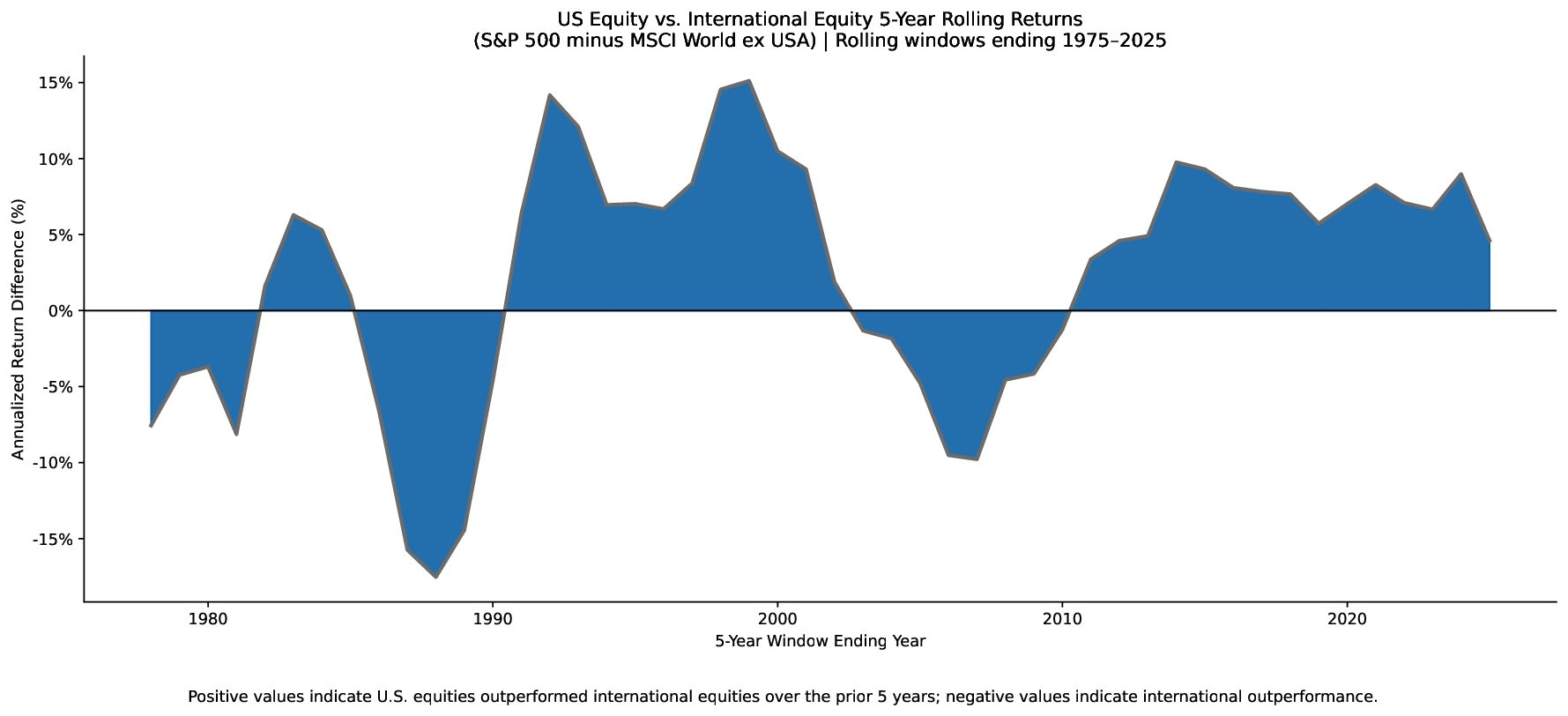
History shows that global leadership can shift. Countries go through cycles of overperformance and underperformance. Japan, once considered unstoppable in the 1980s, experienced decades of stock market stagnation beginning in the 1990s.
No investor can reliably predict which country will lead over the next 10 or 20 years. Investing globally recognizes that no single country consistently leads the market, helping protect your portfolio from relying too heavily on one economy’s performance.
• Different Economies Behave Differently
Countries differ in economic policy, demographics, industry composition, and political environments. Because of these differences, international markets do not move in perfect lockstep with U.S. markets.
When one region struggles, another may be performing better. By combining exposure across multiple countries, investors can help reduce overall portfolio volatility over time.
• Stronger Potential and Long-Term Opportunities
Forward-looking return projections suggest international stocks may offer stronger potential returns over the next decade compared to U.S. stocks. Current estimates project approximately 5%–7% annual returns for ex-U.S. equities, compared with roughly 4%–5% for U.S. equities.
U.S. technology companies — particularly those connected to artificial intelligence (AI) — are priced with high expectations. Even if strong earnings growth materializes, much of that optimism may already be reflected in valuations.
In contrast, many developed markets outside the United States are more moderately valued, which may offer more attractive long-term risk-reward opportunities.
How to Get Started
A simple way to start building a globally diversified portfolio is to allocate investments based on global market capitalization. This means owning U.S. and international stocks in proportion to their share of the overall global stock market. This can be implemented efficiently using low-cost total U.S. and total international index funds.
You should also consider your broader financial picture. If your job and income are tied closely to the U.S. economy, adding international investments can help balance your household’s financial risk.
Patience and Discipline Required
Diversification works over time — but it often feels uncomfortable. When U.S. stocks outperform for extended periods, international stocks may lag. This gap, known as tracking error, is not a flaw but evidence of genuine diversification.
Investors frequently fall prey to recency bias — assuming that recent winners will continue winning. Long-term success requires discipline, patience, and a commitment to rebalancing rather than chasing trends.
Build a Globally Diversified Portfolio Today
International diversification reduces concentration risk, expands opportunity, and strengthens portfolio resilience over time. Rather than trying to predict which country or market will outperform next, the goal of global investing is to create a portfolio that doesn’t rely on any single economy to succeed.
Investors cannot eliminate risk entirely, but they can choose to manage it more effectively through a disciplined global diversification strategy.
Disclosure: This material is for informational and educational purposes only and should not be considered investment advice.
All investments involve risk, including the possible loss of principal. Forecasts and return projections are not guarantees of future performance.
Investors should consult with a qualified financial professional before making investment decisions.