New Year, New Financial Goals: Managing Household Debt
Practical strategies for balancing credit cards, mortgages, car loans, and other financial obligations
The holidays are a wonderful time to celebrate with family and friends. But when January arrives, so do the bills. For many Hawai‘i families, the new year brings a familiar financial challenge: managing holiday credit card debt while keeping up with everyday expenses and monthly loan payments. Credit cards, mortgages, car payments, student loans, and personal loans can all compete for limited household income. The key to managing family debt isn’t necessarily paying off every loan as quickly as possible. It’s understanding what you owe, prioritizing your financial obligations, and creating a realistic debt repayment strategy that fits your budget and supports your family’s long-term financial goals.
Not All Debt Is Created Equal
Not all debt is necessarily bad. Some types of borrowing can serve a valuable purpose and support a family’s long-term financial well-being. For example, a mortgage can help a family purchase a home while spreading the cost over many years. Student loans may finance an education that increases future earning potential. A reasonable auto loan can provide reliable transportation, especially when driving is essential. These are sometimes called “productive debts” because they finance something with lasting value or an important practical purpose. But even productive debt becomes a problem when the payments are unaffordable.
Credit card debt is different from a mortgage or student loan because it typically carries a much higher interest rate and does not finance an asset or investment with lasting value. Rates can exceed 20%, making it expensive to carry a balance from month to month. For instance, a $10,000 balance at a 24% annual rate costs approximately $2,400 in interest over a year if the balance remains unchanged. That interest money could instead support savings or family needs. The key question is whether the cost and purpose of borrowing support or interfere with your long-term financial well-being.
Start by Understanding What You Owe
Before deciding which debts to pay down first, it helps to get a clear, complete view of all outstanding financial obligations. Start by listing each debt, including the amount owed, interest rate, minimum monthly payment, and how much longer you have to make payments. A household might have a mortgage at 3.5%, an auto loan at 7%, a student loan at 5%, and credit cards charging 18% to 25%. The mortgage may be the largest balance, but it is not necessarily the debt that needs the most immediate attention. Looking at the full picture helps families prioritize actual borrowing costs.
Two Strategies for Paying Down Debt
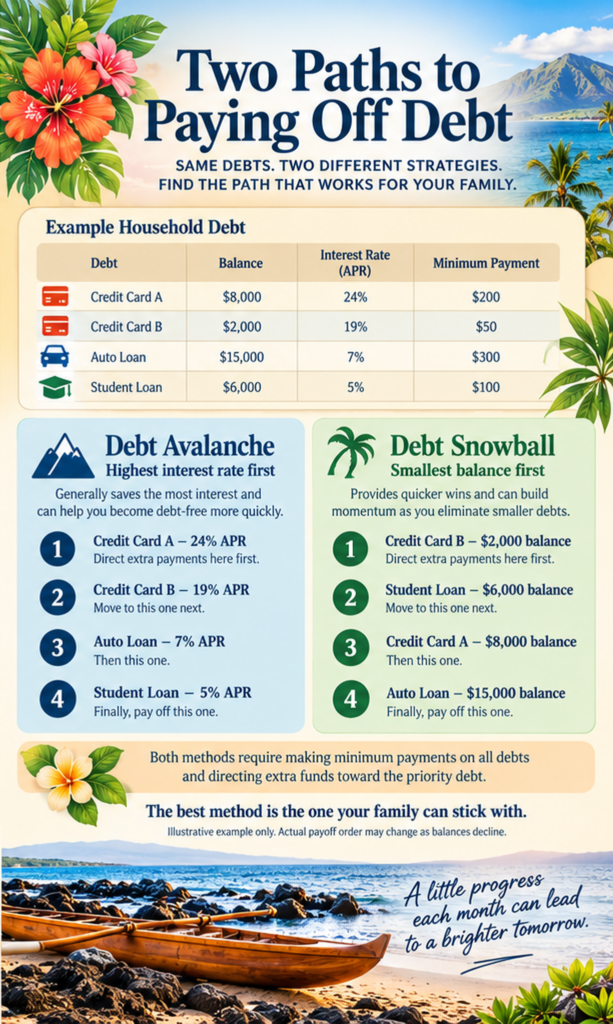
The debt avalanche method focuses on paying off the debt with the highest interest rate first. You continue making the minimum required payments on all other debts while putting any extra money toward the highest-rate balance. Once that debt is paid off, you move on to the debt with the next-highest interest rate. This approach can save money by reducing the total interest paid over time.
The debt snowball method takes a different approach. You focus on paying off the debt with the smallest balance first, regardless of its interest rate. Eliminating a smaller debt can provide a sense of accomplishment and encourage you to keep going.
Neither method is right for everyone. The avalanche method generally saves more money on interest, while the snowball method may help some families stay motivated. Whichever approach you choose, continue making at least the minimum payment on every debt to avoid late fees and other penalties.
Should You Pay Down Debt or Build Savings?
Paying off debt is important, but families also need to balance debt repayment with other financial priorities. Suppose a family has an extra $300 each month. Should it go toward credit cards, emergency savings or retirement? Paying down a 24% credit card can avoid substantial interest, but using every available dollar for debt while keeping no cash reserve may force a family to borrow again after an unexpected car repair or medical bill.
A reasonable approach for many households is to establish a modest emergency reserve, tackle high-interest debt, and gradually increase savings. If your employer offers a retirement plan with matching contributions, consider contributing enough to receive the full match. This is essentially free money that can help grow your retirement savings.
Think Carefully Before Combining or Moving Debt
Moving debt from one account to another may seem like a good way to save money or make payments easier. For example, a balance transfer, personal loan or home-equity loan may help combine debts into one payment, sometimes at a lower interest rate. However, it’s important to look beyond the advertised interest rate. Check for transfer fees, loan fees, how long a lower interest rate will last, and how much time you have to repay the loan. Combining debt only makes sense if it lowers your overall costs, fits your budget, and helps you pay off what you owe without taking on more debt.
What If You Cannot Make Minimum Payments?
If you cannot make minimum payments, contact lenders as soon as possible to ask about hardship programs, modified payment arrangements, or temporary relief. Reputable nonprofit credit counselors may help families evaluate options and develop repayment plans. Before using a debt-settlement service, understand the fees, potential credit consequences and other risks. Seeking help as soon as you realize you may have trouble making payments can give you more choices. Lenders may be more willing to work with you before you miss payments or your accounts fall significantly behind.
Making Debt Management a Family Priority
Managing debt is easier when the whole family understands the household’s financial priorities and works toward shared goals. Couples can start by discussing how much they owe, which debts to pay off first, and how much they can afford to put toward monthly payments. Children can also learn age-appropriate lessons about spending, saving and the importance of borrowing responsibly. Everyday choices can make a difference, too. Reviewing monthly subscriptions, planning ahead for large purchases and setting aside money throughout the year for holiday expenses can help families avoid relying on credit cards to cover unexpected costs.
In Hawai‘i, housing, groceries and transportation can take up a large share of the household budget. Remember, even small changes in spending and saving habits can free up money to pay down debt and build financial security.
Five Steps Toward a Fresh Financial Start
1. Take inventory—list debts, balances, rates and minimum payments.
2. Identify expensive debt—focus on high-interest borrowing.
3. Choose a repayment strategy—avalanche or snowball.
4. Build repayment into your budget while preserving emergency savings.
5. Plan ahead for next year’s holidays with a monthly savings amount.
Financial well-being is not necessarily about having no debt. It is about making sure the debt you carry does not prevent you from living the life you want—today and in the years ahead.