Investment Portfolios: More Than a Collection of Investments
A well-designed portfolio connects investments to financial goals, time horizon, risk tolerance, and long-term priorities.
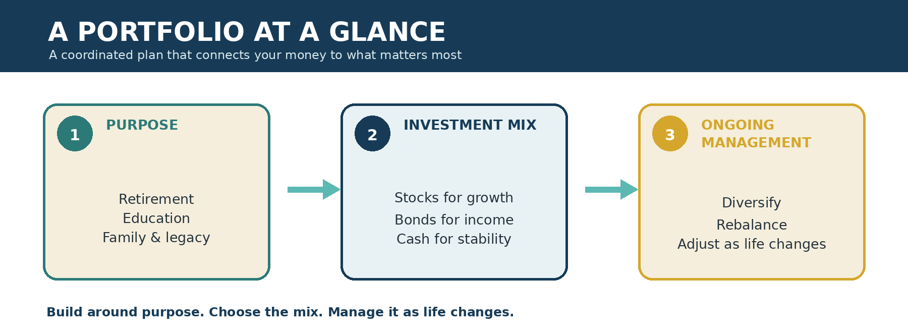
When people hear the word “portfolio,” they may picture complicated charts, stock-market experts, or a long list of unfamiliar investments. In reality, an investment portfolio is a collection of assets designed to help support financial goals and build long-term financial security.
A portfolio might include stocks, bonds, mutual funds, exchange-traded funds, cash, or real estate investments. These assets may be allocated across a workplace retirement plan, an IRA, a brokerage account, and other accounts. An investment portfolio goes beyond the investments and balances listed on a financial statement. A thoughtfully constructed portfolio is a plan—each investment should have a purpose, and all the pieces should work together.
Why Build a Portfolio?
Most people do not build a portfolio merely for the sake of owning investments. They build it because they want their money to support something meaningful.
That purpose might be to retire comfortably, pay for a child’s education, buy a home, create financial independence, leave assets to family members, or support a charitable cause. For many Hawai‘i families, a portfolio may also help address the high cost of living, care for aging parents, or create opportunities for the next generation.
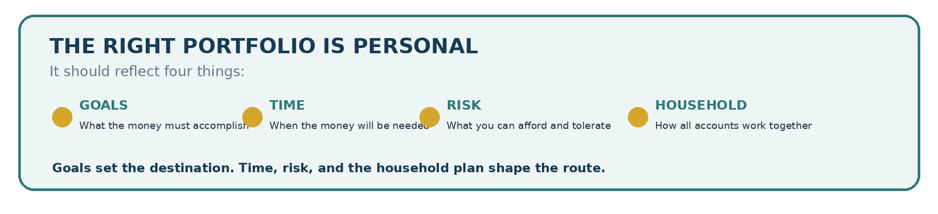
The first question should not be, “What investment should I buy?” A better question is, “What do I need this investment to accomplish?” Money needed for a home purchase next year should be invested differently from money intended for retirement 20 years from now. Similarly, someone entering retirement may need a different balance of growth, income, and stability than someone who is just starting their career. Once the destination is clear, the portfolio can be designed around it.
The Basic Building Blocks of a Portfolio
Most portfolios use three primary types of investments: stocks, bonds, and cash.
Stocks represent ownership in companies. They generally offer greater long-term growth potential, but their values can rise and fall considerably. Stocks can help a portfolio grow and keep pace with inflation over time, although that growth is never guaranteed.
Bonds are loans made to governments, municipalities, or companies. They generally provide interest income and tend to fluctuate less than stocks, although bonds also carry risks and can lose value. Bonds are often used to provide income, reduce overall volatility, and help preserve money that may be needed sooner than later.
Cash and cash equivalents—including savings accounts, money market funds, and short-term Treasury securities—typically offer greater stability. However, holding too much cash for too long can create another risk: inflation can erode its purchasing power over time. No single investment type is best in every situation. The appropriate combination depends on the investor’s goals, time horizon, income needs, and ability to tolerate changes in value.
Choosing the Right Mix
The percentage of a portfolio allocated to stocks, bonds, cash, and other investments is known as its asset allocation.
One portfolio might hold 60% in stocks and 40% in bonds. Another might hold 40% in stocks, 50% in bonds, and 10% in cash. Neither is automatically better—the asset allocation depends on the investor and what the money is intended to accomplish.
A portfolio with more stocks will generally offer greater growth potential, but it is also likely to experience larger declines during difficult markets. A portfolio with more bonds and cash may be steadier, but it may grow more slowly.
This is where risk becomes personal. Risk is not simply a score on a questionnaire. It includes how much loss you can financially afford, how much volatility you can emotionally withstand, and when you will need the money. Someone may feel comfortable with market fluctuations but still be taking too much risk if retirement withdrawals are about to begin. Conversely, someone who avoids all market volatility may face the risk of not earning enough to keep up with inflation during a retirement that could last decades.
Why Diversification Matters
Diversification means spreading money among different investments rather than depending too heavily on one company, industry, or market. A diversified stock allocation may include large, midsize, and smaller companies, along with both U.S. and international markets. A diversified bond allocation may contain different issuers, maturities, and types of bonds.
Diversification cannot prevent losses, but it can reduce the impact caused when one investment or part of the market performs poorly. Consider an island community that relies on a mix of tourism, agriculture, businesses and other industries, rather than depending on a single source of income. If one industry struggles, the others may continue to provide economic support. An investment portfolio works in much the same way. Holding a mix of investments can reduce reliance on any single asset or market segment because different investments may respond differently to changes in interest rates, inflation, economic growth, and overall market conditions.
Remember, simply owning several funds does not necessarily create diversification. Different funds may hold many of the same companies. What matters is not the number of investments you own, but how their underlying holdings complement one another.
Looking at the Entire Household
People tend to accumulate accounts over time—a current workplace plan, an old 401(k), an IRA, a spouse’s retirement account, and perhaps a taxable brokerage account. Each account may have been opened at a different time for a different reason. The key is to look beyond individual accounts and consider how they work together as a complete investment portfolio.
A household may own a conservative fund in one account and an aggressive fund in another. That is not necessarily a problem if the combined investments match the family’s overall plan. What matters is how all of the investments work together.
Where an investment is held can affect its tax treatment and overall tax efficiency. Some investments may be more appropriate for retirement accounts, while others may be better suited to taxable accounts. Coordinating the entire household portfolio can improve organization, tax efficiency, and risk management.
A Portfolio Needs Ongoing Management
Even a well-designed portfolio will not remain perfectly aligned on its own. Markets move, investments grow at different rates, and life circumstances can change.
Consider a scenario in which stocks perform well and increase from 60% to 70% of the portfolio.The investor may now be taking more risk than intended. Rebalancing—reducing investments that have grown and adding to areas that have fallen behind—can restore the portfolio to its target allocation.
A portfolio should also be reviewed after any major life change, such as retirement, marriage, divorce, an inheritance, a home purchase, or a change in health. The goal is not to react to every news headline or market swing—it is to ensure the strategy continues to support the investor’s goals.
Keep the Purpose in Focus
A portfolio does not need to be complicated to be effective. In many cases, a collection of broadly diversified, reasonably priced investments can accomplish more than a complex assortment of frequently traded holdings.
The key is to understand why each investment is included in the mix. Does the portfolio provide enough growth to support future goals? Is there sufficient stability for near-term expenses? Is it diversified? Are the costs and tax consequences reasonable? Can the investor remain committed during uncomfortable market volatility?
A good portfolio should provide clarity rather than confusion. It should reflect your goals, responsibilities, time horizon, and comfort with uncertainty.
In Hawai‘i, we understand the importance of caring for our resources with patience and intention. Building a portfolio is not about predicting every wave in the market. It is about preparing thoughtfully, maintaining balance, and keeping your plan focused on the people and goals that matter most.