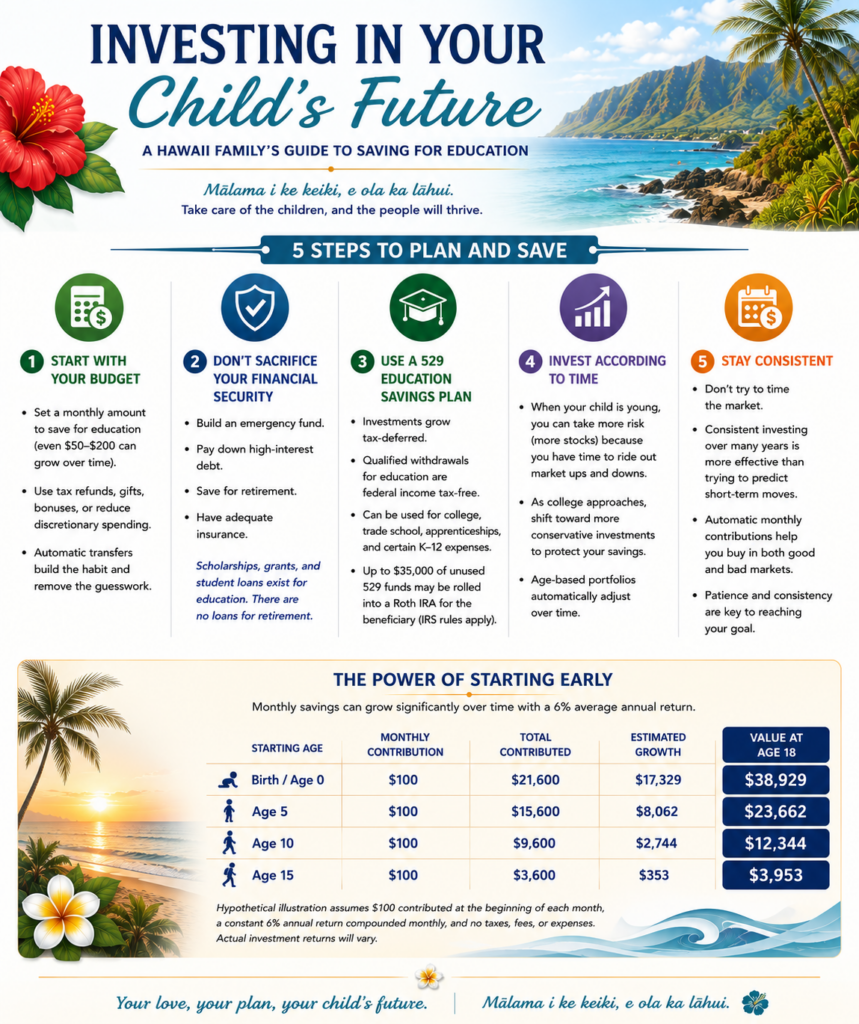
How to Save for Your Child’s Education: Education Savings Strategies for Hawaiʻi Families
For many Hawai‘i families, helping a child pursue college, community college, trade school, or another educational path is one of life’s most meaningful financial goals. A thoughtful plan combines budgeting, long-term investing, and smart use of available tax benefits.
Start with Your Budget, Not Your Investment Account
Saving for your child’s education doesn’t require a large investment portfolio or a perfect financial situation. It starts with creating a plan that fits your family’s budget and making steady progress over time. When you make an effort to build education savings into your finances, you can save for future tuition costs without putting unnecessary strain on your family.
Education planning begins with your available cash flow. Review your monthly spending and identify an amount you can save consistently. Even $50, $100, or $200 a month can become meaningful over many years, especially when contributions begin early.
Treat education savings like a regular household expense rather than waiting for “extra money.” Set up an automatic transfer after each paycheck. You can also direct part of a tax refund, work bonus, birthday gift, or pay increase toward the goal. Trimming subscriptions and other expenses that no longer add value can create additional room in your budget without disrupting your household finances.
Protect Your Own Financial Foundation
Parents naturally want to support their children’s education, but these savings should not come at the expense of their own financial security. Before saving aggressively, build an emergency fund, reduce high-interest debt, maintain appropriate insurance, and continue contributing toward retirement.
Scholarships, grants, work-study programs, and student loans may be available for education. But there are no loans for retirement. A financially secure parent is often in the best position to support children over the long term.
Use a 529 Education Savings Plan
For many families, a 529 education savings plan can be a central part of this strategy. Contributions to this type of savings account are not deductible on your federal income tax return, but investments generally grow tax-deferred. Withdrawals for qualified education expenses are generally free from federal income tax.
Qualified uses may include college and university costs, eligible trade and vocational schools, registered apprenticeship expenses, and certain other education costs allowed under federal law. Hawai‘i does not currently provide a state income-tax deduction for 529 contributions, so families may compare plans based on investment choices, costs, service, and flexibility rather than choosing solely for a state deduction.
Current federal rules may also allow up to $35,000 of unused 529 assets to be transferred over time to a Roth IRA for the beneficiary (subject to numerous requirements, including account-age rules, annual Roth IRA contribution limits, earned-income requirements, and restrictions on recent contributions). This added flexibility can ease concerns about saving more than a child ultimately needs.
Invest According to Time
A 529 education savings plan gives families the opportunity to choose how their contributions are invested based on their goals, timeline, and comfort with investment risk. Like other investment accounts, a 529 plan typically offers a range of investment options, from portfolios designed for long-term growth to more conservative choices focused on preserving savings.
The appropriate investment mix depends heavily on when the money will be needed. When a child is young and college is many years away, a family may be comfortable holding a larger share in stocks because there is more time to recover from market declines. As enrollment approaches, gradually shifting toward more conservative investments can help protect money that will soon be used for tuition and other expenses.
Many 529 plans offer age-based portfolios that automatically become more conservative over time. The objective is not to chase the highest possible return. It is to balance growth with the need to have funds available on schedule.
Stay Consistent Instead of Trying to Time the Market
It’s natural to feel uneasy when the stock market is making headlines or experiencing periods of volatility. However, trying to wait for the “perfect” time to invest can mean missing valuable opportunities to grow your savings. Regular monthly investing—often called “dollar-cost averaging”—allows contributions to continue through both rising and falling markets. Rather than focusing on short-term market movements, staying consistent, giving your investments time to grow, and reviewing your strategy periodically are often the keys to long-term success.
Understand the Tax Incentives
It is important to understand that different education tax benefits work at different stages of the savings process. A 529 plan can provide tax advantages while you are saving and when you withdraw money for qualified education expenses. However, education tax credits generally become available later, when you actually pay eligible costs such as tuition and other approved expenses. Simply saving for a future education goal does not typically qualify you for these credits.
| Tax Benefit | How it works |
|---|---|
| American Opportunity Tax Credit (AOTC) | Up to $2,500 per eligible student per year for the first four years of post-secondary education. Up to 40% of the credit may be refundable, depending on eligibility. Income limits and other requirements apply. |
| Lifetime Learning Credit (LLC) | Eligible taxpayers may claim a federal tax credit of up to $2,000 per tax return for qualified undergraduate, graduate, continuing education, or job-skills courses. It may be claimed for an unlimited number of years, subject to income limits. |
| When to claim | In most cases, you claim the credit on your federal income tax return for the year you paid the qualified education expenses. If you pay tuition at the end of one calendar year for an academic term that begins during the first three months of the following year, those expenses may still qualify for that year’s credit. |
| Avoid “double dipping” | The same expense generally cannot be used for multiple federal education tax benefits. If you use qualified expenses to receive a tax-free withdrawal from a 529 plan, those same expenses typically cannot also be used to claim an education tax credit. |
Be sure to hang on to Form 1098-T, tuition statements, receipts, account records, and evidence of payment. Supporting documents are important when scholarships, 529 withdrawals, and education credits are used in the same year. A qualified tax professional can help identify which family member should claim the student and how to allocate expenses among available benefits.
Look Beyond Tuition
The full cost of education may include housing, meal plans, books, supplies, technology, transportation, health insurance, activity fees, and study-abroad expenses. Not every cost qualifies for every tax benefit, so families should create both a broad spending estimate and a separate list of expenses that are eligible for 529 withdrawals or education credits.
Recognize That Education Has Many Paths
A four-year university is only one route. Community colleges, apprenticeships, skilled trades, technical programs, and professional certifications may provide excellent opportunities at different costs. A flexible education plan should focus on helping a child build skills and pursue a practical path—not simply to fund one predetermined type of path.
Teach Financial Responsibility Along the Way
As children mature, involve them in age-appropriate conversations about budgeting, saving, scholarships, student loans, and the cost of different schools. Discuss how career interests, expected earnings, and borrowing may fit together. These conversations help children become informed participants rather than passive recipients of your plan.
Review the Plan Every Year
An education savings plan should evolve as your family’s needs and goals change. At least once a year, evaluate your contributions, investment allocation, account performance, and expected education costs. Update your plan as your child’s interests and future goals become clearer. Increasing savings over time and reducing investment risk as college nears can help you prepare for upcoming education expenses.
Small steps today can create meaningful choices tomorrow. Start with a realistic budget, save consistently, invest for the time horizon, use tax benefits carefully, and keep your own financial foundation strong. Planning with patience and aloha can help open doors for your keiki while protecting the well-being of the entire ‘ohana.
Important: Tax rules and eligibility requirements can change. This article is for educational purposes and is not individualized tax, legal, or investment advice. Consult qualified professionals regarding your specific circumstances.